
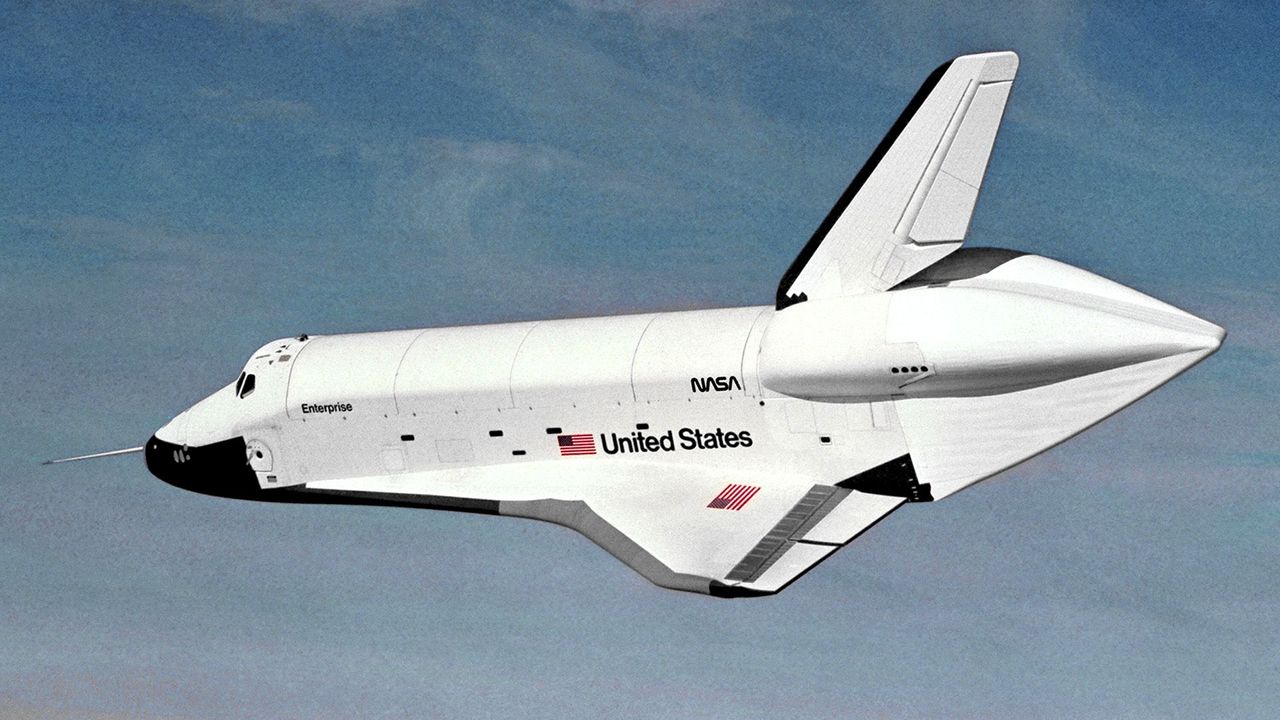
On September 17, 1976, a large hangar for aircraft in Palmdale, California, unveiled something remarkable—NASA’s inaugural space shuttle. The elegant, white spacecraft that emerged was not merely an engineering feat. It was poised to become a cultural icon. Its designation? Enterprise. Although this name had connections to naval history and forward-thinking appeal, it wasn’t NASA’s initial choice. In reality, the alteration came about because of a spirited grassroots movement by devoted followers of a specific science fiction TV series whose mission was “to boldly go where no man has gone before.”
The space shuttle Enterprise was initially slated to be called Constitution, a name meant to honor the United States’ foundational document during its bicentennial. But what followed was a testament to how fandom, public pressure, and government interests can converge in unexpected ways.
At the heart of this movement were John and Bjo Trimble, a California couple whose dedication to Star Trek had already helped the series avoid cancellation during its original run. Leveraging their organizational skills and expansive network of fans, the Trimbles launched a coordinated letter-writing effort aimed at both NASA and the White House. The campaign was simple yet effective: rename the shuttle after the Star Trek starship Enterprise, a vessel that had inspired millions of viewers to dream about space exploration.
The White House got a multitude of letters, leading to internal talks among the officials. William Gorog, an assistant to President Gerald Ford, tackled the increasing public curiosity in a memo. He pointed out that associating the shuttle’s name with a cherished cultural icon might boost public backing for the space initiative and provide a timely lift in national excitement for scientific advancement.
President Ford, personally interested in the concept, gave his approval to the suggestion. NASA’s Administrator, James Fletcher, also appreciated the proposal’s merits, recognizing that public opinion could enhance the agency’s bond with Americans. On September 3, 1976, the name was officially altered to Enterprise.
The shuttle’s reveal became a historic event. Among the dignitaries, engineers, and military officials in attendance were members of the Star Trek cast—including Leonard Nimoy and Nichelle Nichols—who watched proudly as the shuttle emerged to the rousing notes of the Star Trek theme performed by the U.S. Air Force band.
Although the Enterprise never reached orbit, it played a crucial role in shaping NASA’s shuttle program. From 1976 to 1981, the vehicle was used in a series of atmospheric flight tests that helped engineers refine designs for future orbiters. These unpowered glide tests provided critical data, ensuring that the shuttle program’s eventual launches would be successful.
The sequence of shuttles that came after—Columbia, Challenger, Discovery, Atlantis, and Endeavour—benefited significantly from the foundation established by Enterprise. Although it did not have the engines and heat shield needed for missions in orbit, its role in safety checks and procedural creation proved it to be an essential preliminary step towards achieving operational spaceflight.
Beyond the engineering and policy implications, the story of Enterprise is a study in how public imagination and science can intertwine. By naming the shuttle after a fictional vessel from a television series, NASA bridged the gap between speculative storytelling and tangible innovation. It validated the aspirations of millions of fans, many of whom went on to pursue careers in science, technology, and aerospace.
One significant outcome of this cultural exchange was Nichelle Nichols’ collaboration with NASA. Recognized for her pioneering portrayal as Lieutenant Uhura, Nichols was enlisted by the agency in the late 1970s to assist in broadening the diversity of its astronaut team. Her recruitment efforts were crucial in attracting more women and minorities to the space program, contributing to transforming its public perception and personnel.
With the passage of time, the relationship between NASA and Star Trek grew stronger. Elements like mission insignias, crew monikers, and call signs started to show the impact of science fiction. Space travelers frequently mentioned how the series motivated them to fantasize about space, while Star Trek cast members often attended NASA occasions, representing the lasting connection between actual exploration and imaginary journeys.
In 2012, after decades of testing, public exhibition, and transport, the shuttle Enterprise made its final journey—by air, road, and barge—to the Intrepid Sea, Air & Space Museum in New York City. Once again, several Star Trek cast members gathered to pay tribute to the shuttle that bore the name of their fictional ship. This final transfer was more than a relocation; it was a ceremonial closure of a chapter in both space history and cultural memory.
Interestingly, the influence of the fan-led naming didn’t stop with Star Trek. Encouraged by Enterprise’s success, Star Wars fans launched their own campaign to name a shuttle after the Millennium Falcon. Despite the effort, their initiative didn’t bear fruit, but it did further cement the deep connections between popular science fiction and the American space narrative.
The narrative of Enterprise serves as an exceptional example of a government body responding directly to the desires of a devoted fan community. It demonstrates the capability of public advocacy to impact even the most complex and administrative organizations. Additionally, it underscores how the aspirations sparked by television and cinema can extend into tangible accomplishments—propelling innovation, fueling curiosity, and motivating generations to gaze at the cosmos.
In retrospect, Enterprise was never just a prototype spacecraft. It was a symbol of a new era—one that honored the imagination as much as the intellect, and which saw value in merging scientific rigor with cultural resonance. Through the efforts of fans like the Trimbles, and the openness of leaders willing to listen, the name of a fictional starship became part of the history of space exploration.
Today, as new missions prepare to take astronauts back to the Moon and beyond, the story of Enterprise serves as a reminder: the frontier of space is not just charted by engineers and astronauts, but also by dreamers, storytellers, and fans who believe in what’s possible.