
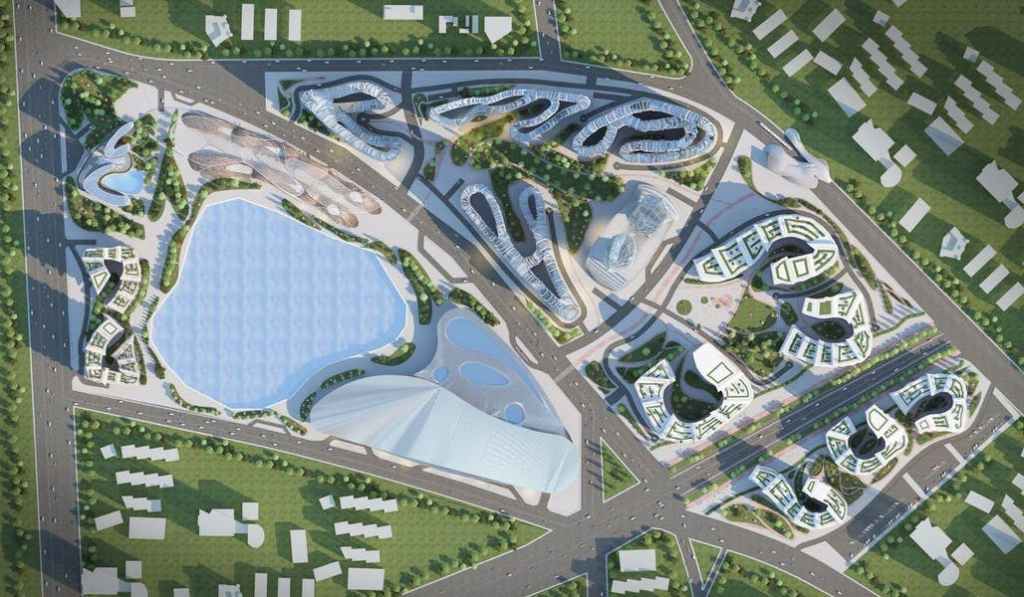
Akon, the Senegalese-American musician and entrepreneur, once captivated global headlines with his bold vision to build a futuristic, $6 billion smart city in his ancestral homeland of Senegal. Marketed as a high-tech utopia powered entirely by renewable energy and utilizing its own cryptocurrency, “Akon City” promised to transform the region by blending innovation with economic opportunity. Years after its grand announcement, however, the ambitious project appears to have stalled, with reports indicating that the city has been largely abandoned.
In 2020, Akon introduced his vision, sparking both enthusiasm and doubt. Taking cues from films such as Black Panther, he envisioned a modern city featuring tall buildings, luxury accommodations, a technology center, and eco-friendly systems. The city’s economy was to be driven by Akoin, a digital currency aimed at boosting African economies. Akon portrayed this initiative as an opportunity to create employment, encourage development, and represent African advancement.
The proposed location for Akon City was a 2,000-acre plot along the Atlantic coast, near the Senegalese village of Mbodiène. The government of Senegal reportedly donated the land, seeing the project as an opportunity to boost tourism, investment, and development. Akon claimed to have secured funding from private investors and envisioned the first phase of construction—consisting of roads, homes, and a police station—completed by 2023.
However, as time passed, little physical progress became evident on the site. Journalists and local residents visiting the area have described the land as virtually untouched, with only a small sign marking the future site of the city. Reports indicate that no major construction has taken place, and many of the ambitious promises remain unfulfilled.
For those residing close to the planned project, the lack of advancement has led to skepticism and disappointment. Many had expected new employment prospects, infrastructure improvements, and advantages fueled by tourism. However, they remain in communities with restricted access to essential services, as the vision of Akon City appears to be becoming more unattainable.
The lack of visible development has fueled speculation over whether the project was ever financially viable or whether it was overly optimistic from the beginning. Large-scale urban developments require significant, sustained investment and coordination—especially in regions where infrastructure is still developing. Some experts have pointed to the challenges of launching such an advanced city in a location without the necessary groundwork in place.
Akon, for his part, has maintained in interviews that the project is still alive, citing delays related to the COVID-19 pandemic and economic disruptions as key reasons for the slow pace. He has emphasized that building a city from scratch is a complex, multi-year undertaking that requires careful planning and resource allocation. Yet despite these reassurances, public trust in the project appears to have eroded as the promised progress remains unseen.
The broader idea behind Akon City—using blockchain technology, green energy, and futuristic design to empower African communities—resonated with many who hoped for transformative change on the continent. Africa is home to some of the world’s fastest-growing economies, and young populations hungry for innovation. Akon’s vision aligned with a larger narrative of homegrown solutions and modern African success stories.
However, the actual implementation of these ambitious undertakings has turned out to be an entirely separate challenge. Akon City is not the initial major project on the continent to experience obstacles. Many proposed smart cities throughout Africa, including Kenya’s Konza Technopolis and Nigeria’s Eko Atlantic, have faced similar postponements, financial hurdles, or scaled-down plans compared to their original assurances.
The gap between visionary ideals and on-the-ground realities highlights the challenges of implementing megaprojects in emerging economies. Issues such as land ownership, financing, government partnerships, and regulatory hurdles can complicate even the most well-intentioned plans. Moreover, the sheer scale of building a futuristic city from the ground up presents logistical challenges that are difficult to overcome without substantial and consistent backing.
For many in Senegal, the story of Akon City is a cautionary tale about grand promises that fail to materialize. While the artist’s intention to give back to his homeland and contribute to Africa’s future development is widely acknowledged, the lack of tangible progress has left many disillusioned.
The situation has also prompted broader conversations about how development should occur in Africa. Critics argue that large-scale, top-down projects often divert attention from more immediate, community-based solutions that could have a more direct impact on people’s lives. Rather than focusing on high-profile, expensive cityscapes, some advocate for investments in education, healthcare, small businesses, and existing urban centers.
Akon’s high-profile involvement brought international attention to the idea of African-led innovation and the potential for economic growth on the continent. Regardless of whether Akon City ultimately comes to fruition, the discourse it sparked about Africa’s future, technology’s role, and the importance of infrastructure and investment remains significant.
Currently, the proposed location is mostly vacant, and the schedule for building it is uncertain. Proponents of the initiative continue to believe the vision can be renewed, whereas critics regard it as yet another instance of unfulfilled promises without the ability to execute.
The tale of Akon City acts as a mirror to the ambitions and challenges of progress in Africa. It highlights the necessity of aligning forward-thinking concepts with realistic implementation, ensuring that the communities potentially impacted by these ventures are not left in prolonged anticipation for transformations that might not occur.
While the fate of Akon’s futuristic city remains uncertain, its legacy may lie less in its physical construction and more in the conversations it sparked about how African nations can harness innovation, technology, and entrepreneurship to shape their own futures—on their own terms.